1969 /
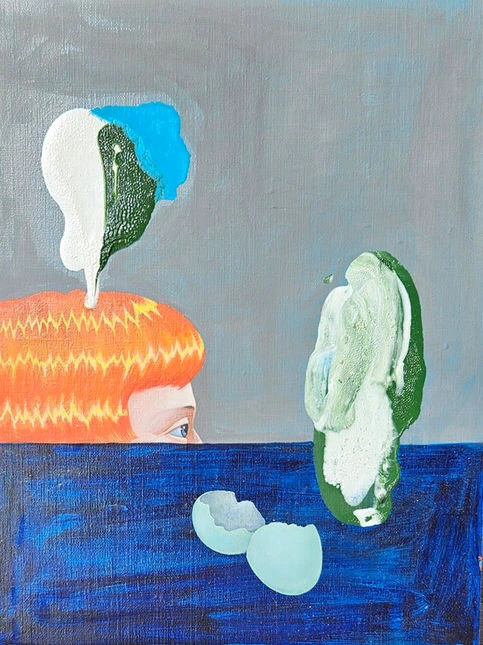
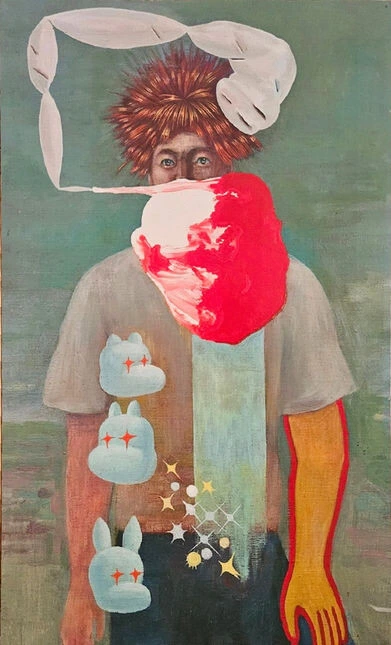
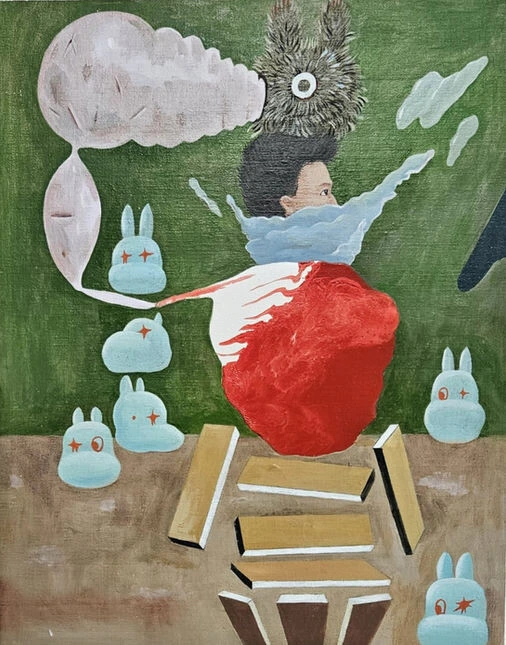
Suejin Chung deals with and explores human consciousness through the medium of painting, emphasizing that it is not the existence of things but the perspective from which we look at them that is important, and that the symbols and linguistic meanings of the figures in the paintings have degenerated, leaving only their visual properties. By asking the viewer the question, 'What is the meaning of that painting?', he creates a multi-dimensional immersive and surreal visual experience by making an iconographic hermeneutic interpretation. He graduated from Hongik University and received his MFA in painting from the School of the Art Institute of Chicago. Since her first solo exhibition at Daegu Sigong Gallery in 1999, she has held solo exhibitions at Project Space Sarubia dabang, Arario Gallery, Doosan Gallery, Gallery SCAPES, and Lee Eugean Gallery, and participated in group exhibitions at the National Museum of Contemporary Art, Tirana Biennale, Shanghai Biz Art Center, and Busan Museum of Art. Major collections include the Korea Arts & Culture Education Service, Doosan Yonkang Foundation, SEONHWA Art and Culture Foundation and the National Museum of Modern and Contemporary Art Art Bank.
Strict freedom
Before Chung's time, square canvases were rarely used in painting. 50x50cm, 100x100cm, more reminiscent of geometry than a screen, the square gives a certain unity to a vessel that holds a variety of things. Rather than a window into something, a visual grammar is created and transformed along the invisible vertical and horizontal axes of a strictly defined game board, such as a chessboard or a checkerboard. Like the relationship between inevitability and chance, there is a paradox of freedom within a strict structure, a heterogeneous logic that creates diversity in Jung's work. There is an ocean-like reality in a small space like a walnut (the brain), as in Jung's "Brain Ocean" exhibition, which I first saw at Sarubia Cafe in 2000. When I say free art, I don't mean that art is actually free, but rather the infinite number of games that can be played within the limited space and time of art. Art, like play, is free in limited space and time, but it can be expanded to other dimensions through ubiquity.
It is the artist who has to play so well that the viewer wants to join in. Since before 'Brain Sea', Jung's magical playground has been a marvel to behold. In the Korean art world, especially among younger artists who are immersed in their own personal worlds, there are many paintings that are dense with iconography and filled with fragmented and divisive narratives. Jung is one such artist, but her differences from them are striking. In the end, it is the difference between the deconstruction of chance particles, which seems like a homophone repetition, or a powerful chance that interacts with inevitability. The "emergence of multidimensional beings" (exhibition subtitle), or diversity, requires more than intermittent chance. It needs to be supported by strong inevitability. This requires a taste for more universal grammars, such as mathematics, geometry, or linguistics. For the artist, it comes from the endless study of the subject and the act of drawing itself. The relationship between necessity and chance is the same as that between consciousness and unconsciousness.
For example, the author says that it's awkward to immediately associate the unconscious with chaos. As Jung observes, "the unconscious has a sophisticated logic system and is guided by it. It's just that the conscious mind "cannot understand the logic of the unconscious and mistakes it for chaos. Just as the unconscious is interlocked with the conscious, the artist has diligently woven a web of necessity for sensory and intellectual enjoyment and enlightenment. Jung is a very logical writer, as evidenced by his book on the logic of visual language, Budo Theory: A New Visual Theory to Read the Multidimensional World of Consciousness, which was published alongside the exhibition. Budo theory is a theory for viewing the logical thought system visually, and the characteristic of this visual logic is that it does not develop logic in the system of right and wrong, but in the system of same and different. When I say logic, I don't mean the dogmatic emphasis of a single arbitrary opinion like a cult leader or a person who suddenly became enlightened one day, or the sloppy encyclopedic knowledge of common sense, but rather what can be called an independent theory of vision.
Jung's "butoh" seems to be a kind of graphical symbols for multidimensional shapes, and the paintings are a product of this unique symbolism. Beyond the everyday dimension of three dimensions, we enter the virtual dimension, and the artist, like a geometer, explores patterns and polyhedra that extend into infinity. The text that accompanies the paintings is a way of showing that certain materials can be transformed from one form to another. A careful researcher with a mathematical brain might be able to analyze Jung's complex paintings into their basic components and translate them into concise visual symbols or schematics. Furthermore, they might be able to identify some secret pathways that add up to the number of dimensions. Jung's paintings and books are consistent within a certain system that is found in those who are paranoid about a certain world. Like religion, if you go beyond the difference between believing or not believing, every belief has its own system and logic. The comparison to religion seems biased, but so does the scientific paradigm that an era chooses.
However, I would not say that the viewer must read the esoteric book to understand the painting. You don't have to be Jung to understand his paintings or visual logic. As a viewer, you can only approach the work centered on what is outside. Although there are some works like [Surprised by the definitive stipulation of the external factual situation]. If the artist expresses from the inside out, the viewer digs in from the outside in, and it is unknown where the two will meet. Unusually, there is not a single drawing in the booklet, which is supposed to be a theory to explain his paintings. The book looks more like another piece of written work than an explanation. Visual logic and painting are mutually enabling, but not a one-to-one correspondence. There's a bundle of logic over there, and here's a bundle of pictures. Visual logic, as well as criticism, is not a reproduction of a given object, nor is it a representation in another language.
If so, it is a homonymy, and one is unnecessary or incomplete. They have a parallel, or corresponding, relationship. They are not warriors, but resonators. The head and the hand cannot be a complete unity, like the relationship between a horse and an object. Neither is it reducible to an abstract idea, nor to mindless drawing labor. What is interesting to us is that the logic and the drawings came from a human being, and we wonder if the book was a way of avoiding the painful questions that would be asked of the artist about the content of his enigmatic drawings-"It's all there," and that's it? That's not to say that the book doesn't have answers to the paintings. They clearly point to the places where the answers are, but it's not as easy as reading the illustrations to determine their clear meaning. Jung clearly points to the unclear. The paintings show concrete shapes, but their content is hard to read, and like a screen that mixes detailed drawings and smudges, the work and its logic are a stage of paradox.
Consider the title of one of the works on display [Variable dictation-narrative-structured factual situations represented by a girl's face, as shown in National Geographic, January 2002, p. 14], and the various representations of inner feelings that surround them. This very 'specific' title does not guarantee any more certainty than the artist's previous favored title "Untitled"-there is only one painting in the exhibition titled "Untitled," in which a mask that looks exactly like the face behind it floats in front of it. The titles of all the works are long enough to make you laugh out loud, but I don't think a few more lines would change that. As well as the obvious meanings of "narrative structure" and "representations," the titles also have uncertain (or variable) meanings, such as "variable," "situation," and "various inner sensations. The artist states that there are "64 morphological elements and 64 conceptual elements" in his work. If there are that many, it would be hard to be an element already.
A group-theoretic systematization of morphemes and concepts would be a way to classify and quantify existence in the same way that biologists, chemists, or mathematicians do, and a field with dozens of morphemes and concepts would generate a huge number of combinations. Because it's not an abstraction, it's hard to know how it will be combined. For example, the combination of vertical/horizontal and tricolor would be far more complex than Mondrian's work of a certain period. The word "multidimensional" is the most common word found in books, exhibition titles, artwork titles, and other conceptualized sentences. The paintings with "the emergence of multidimensional beings (or creatures)" (exhibition subtitle) are "multidimensional geometries". The multidimensionality of these paintings is a logical reason to continue painting in the computer age. In today's age of information revolution, painters must have their own answer to the question of why they paint, and that answer must be as universal as possible. The answer cannot be "me," which many artists hold as collateral. It's even more ridiculous if it's for 'painting itself'. The subject or painting is at the end of the artistic pursuit, not the beginning.
Jung compares humans to computers. But they are as different as they are similar. Painting is an open system performed by humans, who are more intuitive computers than computers as mechanical algorithms governed by closed forms. It was the modern mathematician Riemann who made 'manifold' not just a predicate, but a manifold - each manifold is determined by n factors - a real thing. The amorphous blobs and traces that have been appearing on Jung's screen for several years now illustrate that manifolds are associated not only with geometry, but also with complex flows such as turbulence. The geometric metaphors implied in "Multidimensional" are abundant. The works feature shapes and organisms that would be impossible in three dimensions, and polyhedra are given aquatic life, such as running feet. It is the brain that makes us think of invisible worlds and dimensions. Walnuts, which often appear in Jung's paintings, are reminiscent of the brain. Just as the onion, which has appeared in her previous works, symbolized a difficult hermeneutic cycle without a core, the brain, which folds infinite folds into a limited space, is an extraordinary being that can be compared to the painting itself, and various events take place in this unknown continent.
The line from Shakespeare's Hamlet, "I may be trapped in a walnut, but I may think myself king of an infinite space," is perhaps the most famous metaphor for the brain, which has imagined and discovered many different ways to think about space, including geometry. The geometry in his work is so flexible that it can be found in cartoon characters and even holes in bread. The smudges and traces often found on the screen, which seem to have a certain order to them, are reminiscent of sequences or proliferating images, a situation in which something comes into existence and disappears. In order for change to be possible, the concept of a vacuum or void is essential, as argued by ancient atomists. There are many titles in the work that include the word "void," including "The Emergence of a Face from a Conceptualization of a Void. [In some works, such as "Analytical Conversation on the Void in a Multidimensional Poeticized Place," a white space is visible behind a hole in the screen. The ball is not simply empty, but rather a space for transformation.
When it is combined with a thinking or reading figure or head, it can be seen as a shifting (un)conscious flow that develops from the person on the screen. It gives potential movement to painting, a static medium. Paintings that suggest repetition or self-directed situations suggest that multidimensional painting has nothing to do with representation. Like mathematics, painting is produced by an inner logic, an abstract and symbolic structure, which is powered by an inner logic. The structures are often considered real. Drawing or imagination refuses to remain intellectual play anymore. Multidimensionality in art can be linked to experimentation. James Joyce has been considered an avant-garde-artist who linked stream of consciousness and linguistic experimentation-sentences beginning with the phrase "the composition of an avant-garde poem created..." often appear in the titles of his works. Works with the word "multidimensional" in their titles are characterized by juxtapositions of discontinuous screens with strange beings, such as humans, woven into geometric patterns, as well as openings to other dimensions.
Each dimension contains different states of being, and they coexist without contradiction on the same screen. There is no single geometry in Jung's work, but rather a variety of geometries that follow their own logic. In his biography of the geometer Coxeter, King of Infinite Space, Siobhan Roberts writes that 'there are many geometries, and each of them describes a different world, like fairy tale countries and utopias'. They are "places that are novelty different from the world we live in. In Jung's work, bizarre transformations or multiplications take place in a series, like in the work Pure Drinks, which informs the concept of the ball. It refers to the properties of a shape that are preserved even when it is deformed through stretching, twisting, pressing, etc. like topological mathematicians. There are polyhedra in the work that are homeomorphic, like the relationship between a cube and a sphere in topological geometry. This geometric imagination is not expressed in mathematical logic and axioms, numbers and equations, but rather in rich visual imagery that is driven by intuition.
Jung's work is a rich metaphor for a world that is not here and now. Such 'multidimensionality' goes beyond the geometrician. Just as Coxeter, a 20th-century adherent of classical electrodynamics, emphasized that math should be learned like swimming or riding a bike, not as rigorous engineering. In Jung's works, multidimensional geometry is present in the bread for breakfast or the girl jumping rope. [Like Kepler, who wrote The Mysteries of the Structure of the Universe and The Harmony of the Universe, or Newton, who tried to explain the "system of the world," Jung explores the world of painting with a quasi-scientific passion. It is the study of figures, like geometry, but it does not mean simply translating a specific geometry into a picture. Her paintings are far from being filled with shapes or numbers. They are dimensional analogies. Just as geometry is a means of elaborating mathematical analogies, so is painting.
The word "emergence" in the exhibition's subtitle introduces a fourth dimension of time to the usual coordinate axis of vertical and horizontal. Spatial analogies are important to the artist when dealing with the higher dimensional realm of hyperspace, or n-dimensional geometry. [According to the King of Infinite Space, higher dimensions can represent any number or characteristic of existence. For example, the fourth dimension could be temperature or wind direction, the fifth dimension could be the interest rate on a credit card, the sixth dimension could be age, and so on. Each measured attribute adds another dimension. You could go up to hundreds of dimensions, but to what end? [Coxeter, the geometer in King of Infinite Space, says that modern geometry doesn't have a purpose much different from that of the Pythagoreans. It's an aesthetic purpose-the Pythagoreans wanted to hear the harmonious music of the universe (the celestial bodies) in numbers.
Coxeter said, "A mathematician is a pattern maker, like a painter or a poet. A mathematician's patterns must be beautiful, just like an artist's or poet's patterns. Ideas must fit together in a harmonious way, like colors or words. Beauty is the first criterion. Ugly mathematics has no place in the world forever. Coxeter, for example, studied the "compactification of modularized spaces" in this context, and in his lecture on "Dense Fillings and Bubbles" he even formulated the number of bubbles in contact with a single bubble in a bubble mass. There are strange people in this world who study things that have no immediate utility. I would argue that painters are one of them. In the quest for beauty that binds them, usefulness, such as social meaning or material gain, is an afterthought. They find themselves as "hermits in their own heads" (Siobhan Roberts). The world that geometers and painters indulge in is filled with delightful mysteries that are different from the chaotic world around them. So Jung's esotericism is delightful.
Sunyoung Lee (Art Critic)